

Online exam prep

Ready to get started?

Up-to-date official questions, smart learning, practice tests just like the real exam and an AI helper always at hand. All in several languages. Pass on your first try with us.

LICENCE
GET READY FOR THE EXAM

Incredibly helpful test prep tool

This service was incredibly helpful to prepare for the driving theory test. It was easy to use, the translations were accurate, and it included all of the questions from the actual exam. The electronic format was just like the actual theory test as well. It helped me pass the test with 100% accuracy!

David Evans Jan 2022
Some feedback

I experienced a very quick response to a query and assistance to resolve. In addition, some of my sample test questions came up in the actually theory test which proved very useful. Overall though, excellent customer service and the tool functioned very well.

customer Apr 2022

Profesionál driving licence

Yes, very helpful for me and i have already my driving license here in Czech Republic ..thanks a lot 😊😊😊

Maruska Jan 2022

The registration took a few attempts

The registration took a few attempts. Otherwise, everything went smoothly. In the end, the same questions appeared in the test, so I was well prepared.

Uri Gankin Jan 2022

Nice to practice

Nice to practice, thanks

Regina Nov 2022

Algorithm that chooses the questions could be better

The questions and answers are reliable. The only problem is, the algorithm that chooses questions for each test is not great. The tests are simpler than they should be. One has to take more tests to go through more questions, as the algorithm does not add new questions regularly enough. Having said that, this is still invaluable for anyone who needs to study theory in English.

RS May 2023
What you’ll find in the app

Everything you need

Tools that will get you to your exam.

AI helper

Don’t understand a question or a rule? Ask Elko.

Smart learning

A highly effective way to learn with flashcards and spaced repetition.

Official test simulation

A simulation of the final test, time limit included.

Targeted tests

Practise exactly the topic you’re interested in, or the questions you struggle with.

Answer explanations

Most questions come with an explanation that tells you in plain words why that answer is the right one.

Detailed progress overview

Your practice test history and an overall picture of how ready you are for the final exam.

Listening to Questions and Answers

Have the texts read aloud. Ideal for those who memorize better by listening.

Always up-to-date questions

The questions are based on materials from the Czech Ministry of Transport and are updated regularly.

Multilingual support

The app supports several languages. For every translated question you can also show the Czech wording you’ll see at the exam.

Search

Advanced question search by keyword.

Notes

Write your own notes on questions to help you remember them more easily.

Colour scheme

Choose dark or light mode in the app.

A taste

What awaits you in the app

Try it right now, no sign-up needed.

Exam simulation

Try an exam-style test where you need to answer 25 questions within 30 minutes and score at least 43 out of 50 points.

B Question 1 of 25
30:00
06060413

Driving a vehicle from the view:

They must give way to the red vehicle because it is coming from the right.
He does not have to give way to a red vehicle coming from the right because this vehicle is in the connecting lane.
They must reduce their speed to allow the red vehicle on the right to pass.
06060392

The connecting lane is:

Lane reserved for public passenger transport vehicles only.
A lane designated for slow vehicles that cannot reach an instantaneous speed of at least 60 km/h on a given section.
A lane intended for placing vehicles in the through lane.
06040308

The driver of another vehicle must follow a public passenger transport vehicle that has stopped at a bus stop in a municipality without a boarding island or without a platform on a raised tram lane:

Reduce the speed of the vehicle to take into account the safety of passengers entering and exiting the vehicle.
The vehicle shall stop; if there are several public passenger transport vehicles at the stop, it shall stop behind the second of them, and shall only resume driving if it no longer endangers passengers who are getting on or off.
Stop the vehicle even if a public passenger transport vehicle stops at the edge of the road.
06040276

A driver of a vehicle who is unwilling or unable to pass a tram on the right:

He must follow the tram at a distance that allows other drivers to pass him.
They must continue to follow the tram to a point where they can pass alongside the tram on the right.
They must stop the vehicle and allow other drivers to pass alongside the tram.
06040240

A vehicle is passing an obstacle on a road. Does its driver have to signal a change of direction?

Yes.
No.
06060049

If drivers of oncoming vehicles turn left:

They are avoiding on the left (their vehicles are passing on the right side).
They are avoiding on the right (their vehicles are passing on the left side).
Avoid right and left in the intersection as circumstances and space permit.
06040287

The driver of a motor vehicle may give a warning signal by briefly intermittently switching on the main beam or by switching on the dipped and main beam:

Only outside the village when overtaking to warn the driver of the overtaken vehicle.
Only to avert an imminent danger or to warn the driver of a vehicle being overtaken.
If he wants to warn other drivers about the road check.
06060398

If a merge lane is provided for merging into the through lane:

Is the driver obliged to use the connecting lane before entering the passing lane.
The driver does not have to use it before moving into the passing lane, as long as he does not restrict or endanger other drivers by moving into the passing lane.
Is the driver required to reach a speed of at least 80 km/h before moving into the passing lane.
06060380

You can only stop with your vehicle in the second row if:

If at least one lane at least 3 m wide remains free.
If the vehicle cannot be stopped at the edge of the road at a distance of less than 100 m.
If you are transporting a severely disabled person or a person with severe physical disabilities.
06040251

After overtaking another vehicle, you intend to move in front of that vehicle. Do you need to signal a change of direction?

Yes.
No.
06060056

This warning sign warns drivers:

06060056
On a stretch of road where it is dangerous to drive on the shoulder.
A place or section of road where parking on the shoulder is permitted.
To the scene of an accident.
06060407

In the illustrated situation:

Must the driver adjust his driving with the assumption that he will reduce his speed over the horizon or stop before a pedestrian crossing.
The driver must reduce his speed as he is warned by a road sign of a section of road where local conditions make descending dangerous.
Does the driver have to reduce his speed because of an artificial unevenness in the road, the purpose of which is mainly to reduce the speed of moving vehicles.
16010008

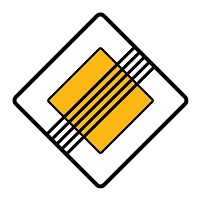
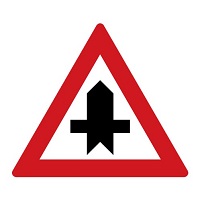
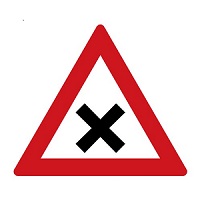
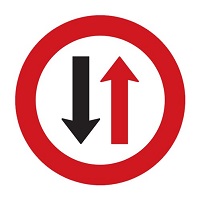
Which of the pictured traffic signs does not govern the right of way.

06060275

The cause of aquaplaning is:

Driving fast on a road covered with a large amount of water.
Rapid acceleration of the vehicle on a wet road.
Braking the vehicle hard on wet roads.
06050504

The minimum safe distance between consecutive vehicles is generally considered to be:

Time interval of two seconds.
Time interval of five seconds.
Time interval three quarters of a second.
06060425

What can cause a vehicle to skid when cornering?

Light weight of the vehicle.
Large differences in inflation of individual tyres.
Light weight of cargo.
06050499

On the motorway you have to take into account strong crosswinds in particular:

On the bridges.
In underpasses.
Between the noise barriers.
06050508

The vehicles will pass through the intersection in the following order:

1. vehicle in view, 2. white vehicle, 3. red vehicle.
1. white vehicle, 2. red vehicle, 3. vehicle in view.
1. vehicle in view, 2. red vehicle, 3. white vehicle.
06060502

You are the driver of the vehicle from the view. In the depicted traffic situation:

You may turn left without giving way to anyone.
You must not turn left, as the green full-circle "Clear" signal only allows you to pass through the intersection in a straight line.
You are allowed to turn left, but you must give way to pedestrians crossing at a pedestrian crossing.
06050022

You are the driver of the vehicle from the view. At the pictured intersection:

You have the right of way over both green and yellow vehicles. The yellow vehicle will be the second vehicle through the intersection and the green vehicle will be the last vehicle through the intersection.
You must give the right of way to a yellow vehicle because it is on a main road and to a green vehicle because you are turning left.
You must give the right of way to a yellow vehicle coming down a main road. The driver of the green vehicle must give way to you.
06060086

If a defect is found in the braking system which clearly prevents the vehicle from stopping effectively and thus endangers road safety:

The vehicle can be operated on the road with a one-time police permit.
The vehicle can only be driven at a reasonable speed to the nearest place where the fault can be rectified.
The vehicle may not be used for road traffic, but may be towed on a pole.
06060442

Mandatory equipment for motor vehicles and trailers must be placed in the vehicle:

Every time the vehicle is used in traffic on the road.
Only if the vehicle is brought to the MOT test.
Only if it does not interfere with the normal use of the vehicle.
06060040

The holder of a driving licence is obliged to notify changes to the information recorded on the driving licence:

Within five working days from the date of the change to the competent municipal authority of the municipality with extended jurisdiction.
Within five working days from the date of the change to the relevant traffic police department.
Within fifteen working days from the date of the change to the competent municipal authority of the municipality with extended jurisdiction.
06060042

International driving licence holder:

You must not make any entries, changes, corrections or modifications to your international driving licence.
They are only allowed to make corrections on the international driving licence where it is obvious that the information is incorrectly filled in.
They may only make necessary changes and corrections to the international driving licence if they notify the competent municipal authority of the municipality with extended jurisdiction on the next working day.
11020010

What to do if you are alone and repeatedly fail to secure your airway:

I will continue to retry until I succeed
I'll abort after 3-4 attempts and start external cardiac massage
I will give up any further activity

To see the test result, you need to log in.

Sign flashcards

Do you know this sign? If so, great! If you’re not sure, click it to see the right answer.

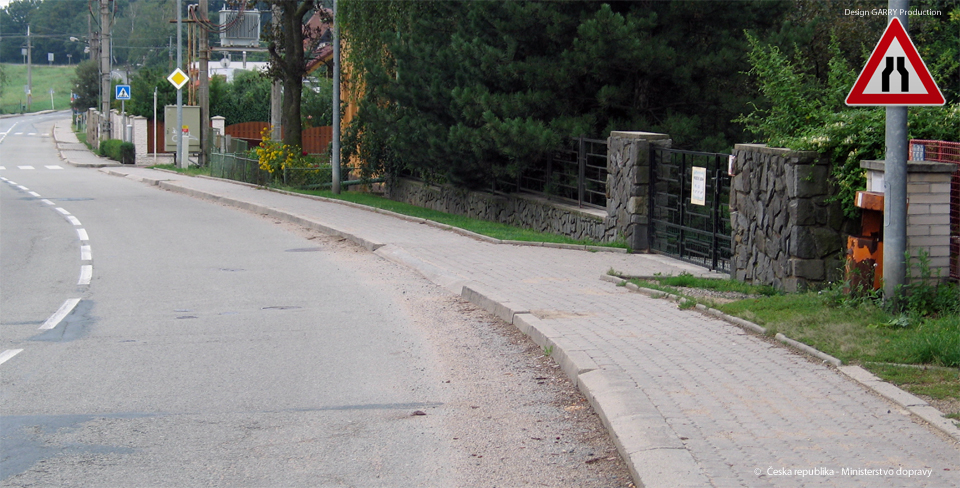
How do you behave in a place with this warning sign?

Correct answer

I will adapt my driving to the fact that the roadway narrows considerably compared to the previous section, on both sides

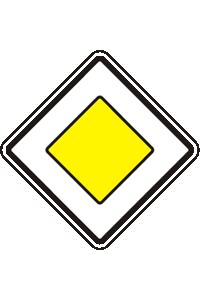
This road sign indicates:

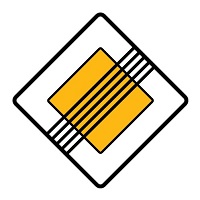
Correct answer

Main road

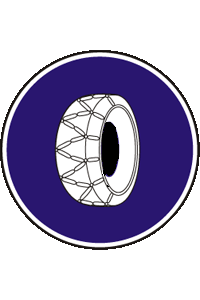
Traffic sign shown:

Correct answer

It requires the driver of a motor vehicle with three or more wheels to continue driving only after snow chains have been fitted to at least two driving wheels.

This tag highlights:

Correct answer

A place where the roadway narrows significantly from the previous section on both sides.

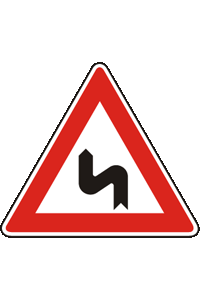
This traffic sign:

Correct answer

It points out two or more successive bends (directional curves), the first of which is to the left, which require a significant reduction in driving speed to pass safely.

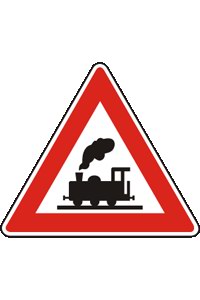
This traffic warning sign:

Correct answer

It warns the driver of a level crossing not equipped with barriers.

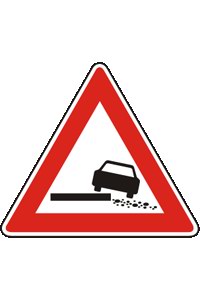
This warning sign warns drivers:

Correct answer

On a stretch of road where it is dangerous to drive on the shoulder.

This traffic sign:

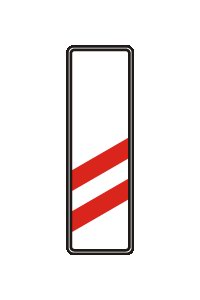
Correct answer

It is placed at a distance of 160 m in front of the level crossing to which it draws attention.

This traffic sign:

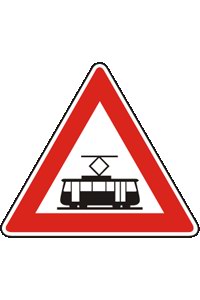
Correct answer

It draws attention in particular to the point where the tram crosses the direction of travel of other vehicles.

This traffic sign:

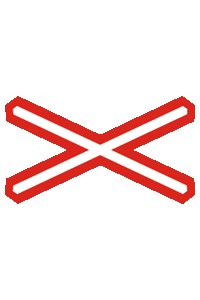
Correct answer

It draws attention to a single-track level crossing. If a driver is obliged to stop his vehicle before a level crossing, he shall stop in front of this sign.

This traffic sign:

Correct answer

It is valid only for the nearest intersection.

Behind the nearest vertical traffic sign as the driver of the vehicle in view:

Correct answer

You have the right of way over oncoming vehicles.

In the section after this traffic sign:

Correct answer

The driver is allowed to drive at a maximum speed of 20 km/h.

In the section after this traffic sign:

Correct answer

A driver may stop only in places marked as parking lots; however, he may stop outside parking lots.

In the section after this traffic sign:

Correct answer

The driver must take extra care to avoid endangering pedestrians.

Behind the pictured pair of road signs:

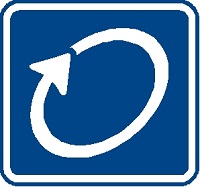
Correct answer

The driver will be entering a roundabout; he must give way to vehicles travelling on the roundabout.

If as a driver you see this symbol on the road, you must:

Correct answer

Adjust your driving to the fact that you are approaching a pedestrian crossing.

In the situation shown in the picture, the driver must take into account that:

Correct answer

A pedestrian crossing is warned in advance by a traffic sign, which will be followed at a distance of 150 m.

Behind this road sign:

Correct answer

The driver may stop for the time necessary to immediately take on or alight the persons being transported or to immediately load or deposit the load; however, he may not stand there.

Behind this road sign:

Correct answer

It is forbidden for a driver to drive at a speed of more than 30 km/h.

In the illustrated situation:

Correct answer

Must the driver adjust his driving with the assumption that he will reduce his speed over the horizon or stop before a pedestrian crossing.

Is it possible to stop at the nearest traffic sign in order to get out of the vehicle without delay?

Correct answer

Yes.

Which of the pictured traffic signs does not govern the right of way.

Correct answer

Which of the pictured traffic signs does not govern the right of way.

Correct answer

Which of the pictured traffic signs does not govern the right of way.

Correct answer

Browsing questions

Use the arrows to browse real exam questions. The correct answer is highlighted in green, with an explanation of why underneath.

06060015

Historical vehicle:

Why this is correct

A historic vehicle serves to preserve cultural heritage, not for business or ordinary everyday use for one's own needs – so it may not be operated for such purposes. At the same time it may be operated without permission of the Czech Police and some limited use on the roads is allowed, so neither a total ban nor unrestricted operation applies.
06060086

If a defect is found in the braking system which clearly prevents the vehicle from stopping effectively and thus endangers road safety:

Why this is correct

A brake defect that clearly prevents effectively stopping the vehicle is a dangerous defect – the vehicle is technically unfit and must not be used on the roads. You may, however, tow it on a rigid bar, because when towing on a bar the towing vehicle provides the braking. So you cannot 'drive it to the nearest repair shop' nor drive on a one-off police permit.
06060087

The time limit for bringing a road vehicle for a periodic roadworthiness test is calculated from:

Why this is correct

The period for bringing a vehicle to a regular technical inspection is counted from the day of the vehicle's first registration, and thereafter always from the day the previous regular inspection was carried out. It is not tied to the day of sale or manufacture, and no flat five-year period applies.
06060088

A vehicle is technically unfit for use on the road if:

Why this is correct

A vehicle is technically unfit for operation when, due to defects in its technical condition, it immediately threatens road traffic safety (a dangerous defect). An approaching date of the next inspection or higher fuel consumption do not in themselves mean unfitness.
06060091

An unbraked trailer whose permissible weight does not exceed 750 kg and which has not previously been registered abroad shall be delivered by its operator for technical inspection no later than the deadline:

Why this is correct

An unbraked trailer up to 750 kg (category O1) must be brought to its first technical inspection no later than 6 years after its registration, and then regularly at intervals of no more than 4 years. The shorter periods of 2 or 4 years for the first inspection do not apply to it.
06060094

The following may be used to power vehicle engines:

Why this is correct

For driving vehicle engines only the fuels prescribed by the maker of those engines may be used. You must not use fuel with a lower octane number, nor fuel that fails to meet the required quality, even if the engine would 'somehow' run.
06060251

A historic vehicle is:

Why this is correct

A historic vehicle is a vehicle that is entered in the register of historic and sports vehicles and for which a historic vehicle certificate has been issued. The vehicle's mere age is not decisive – what matters is the entry in the register and the historic vehicle certificate.
06060252

A historic vehicle is:

Why this is correct

A historic vehicle is one entered in the register of historic and sports vehicles for which a historic vehicle certificate has been issued. It is therefore not enough that the vehicle is older than 15 or 20 years – the entry in the register and the issued certificate are decisive.
06060265

The operator of a passenger car which has not been previously registered abroad shall deliver the car for technical inspection no later than the deadline:

Why this is correct

You must bring a passenger car (category M1) to its first regular technical inspection no later than 4 years after its first registration, and then regularly at 2-year intervals. The combinations 4 + 4 or 2 + 4 years do not apply to a passenger car.
06060427

The following must be used on the same axle:

Why this is correct

On the same axle you may use only identical tyres, i.e. tyres of the same size, construction, tread type and make. The same size alone is not enough. Different tyres on one axle worsen the vehicle's handling and braking.
06060428

Use of tyres with non-slip studs:

Why this is correct

Tyres with anti-skid studs are prohibited for ordinary traffic; only vehicles of certain services (for example the emergency medical service) are exempt. So they are not generally permitted winter equipment, nor may they be used only in mountain areas.
06060429

The active surface of the tyre casing in service shall have a clearly visible tread pattern with the depth of the main tread grooves around the entire circumference and across the width of the top tread:

Why this is correct

The main tread grooves must have a depth of at least 1.6 mm around the whole circumference and across the full width of the tread; for mopeds at least 1.0 mm is enough. The values 1.0 mm for all vehicles, or 1.5 mm for cars and 2.0 mm for trucks, are not correct.
06060431

New trailers for cars:

Why this is correct

A trailer for a passenger car is a road vehicle that is subject to registration – it must be entered in the register of road vehicles and receives its own registration plate. Registration is neither voluntary nor dependent solely on the owner's request.
06060432

Newly registered trailers:

Why this is correct

A newly registered trailer receives, after registration, its own allocated registration plate. It does not share a plate with the towing vehicle and must not be without a registration plate.
06060434

Other than prescribed or permitted lighting devices:

Why this is correct

Lighting devices other than those prescribed or permitted must not be used on the vehicle at all – regardless of whether they would disturb others, and regardless of any 'tuning'. Only lighting prescribed and permitted for the given category may be on the vehicle.
06060439

The instantaneous weight of the combination:

Why this is correct

The actual mass of a vehicle combination must not exceed the maximum permitted combination mass laid down when the towing vehicle's technical fitness was approved. So it cannot be increased at will, even if general limits of a decree would 'allow' it.
06060440

If the dimensions of the trailer, when attached to the towing vehicle, prevent the driver from seeing properly through the exterior rear-view mirrors:

Why this is correct

If the connected trailer, by its dimensions, prevents proper vision through the exterior mirrors, the towing vehicle must be fitted with additional mirrors with greater projection or another device ensuring proper vision. Without securing vision you must not use the combination, not even on lower-class roads.
06060442

Mandatory equipment for motor vehicles and trailers must be placed in the vehicle:

Why this is correct

The mandatory equipment of motor and towed vehicles must be present in the vehicle every time it is used in road traffic, not only when driving to the inspection station. Its presence does not depend on whether it 'gets in the way' somewhere.
08120023

If the roadworthiness test of the vehicle finds a dangerous defect:

Why this is correct

A dangerous defect immediately threatens driving safety, so the vehicle is technically unfit for operation and must not be used in traffic. Unlike a serious defect, no 30-day period applies here. The inspection station is not obliged to remove the defect – that is the operator's responsibility.
08120025

The conversion of a road vehicle is:

Why this is correct

A conversion of a vehicle means a change or modification of essential parts of the mechanism or construction of a vehicle in operation. An ordinary repair using spare parts, or adding approved equipment, is not a conversion. That is why the first answer is correct.
08120026

The following is considered to be a conversion of a road vehicle:

Why this is correct

A conversion is a change or modification of essential parts of the mechanism or construction of a vehicle in operation. Merely replacing an essential part with an identical spare part, or adding approved equipment, is not a conversion. That is why the first answer is correct.
08120028

Manufacturer of engines, systems and equipment for vehicle propulsion:

Why this is correct

For propulsion and lubrication you may use only the fuels and operating fluids prescribed by the maker of the engine, system or vehicle. The maker therefore prescribes them bindingly, not merely recommends them. That is why the first answer is correct.
08120035

The technical inspection station may, during the regular technical inspection:

Why this is correct

During a technical inspection the inspection station (STK) does not repair or adjust the vehicle – it only checks its condition. The only exception is a simple adjustment of the headlamps (and of the engine's idle parameters), so the first answer is correct. The station may not adjust the braking system, steering, axle or the engine's control functions.
08120036

A road vehicle is roadworthy if:

Why this is correct

A vehicle is technically fit for operation if the inspection found no defects, or only minor defects. Minor defects therefore do not rule out fitness – but you must remove them. So it is not true that no defect at all may be found.
08120037

If a road vehicle is found to be seriously defective, the vehicle is:

Why this is correct

If a serious defect is found, the vehicle remains technically fit for only 30 days from the day the inspection result was recorded. Within this period you must remove the defect and bring the vehicle for a repeat inspection. A serious defect therefore does not ban operation immediately, but limits it in time.
1/25

Elko, the AI assistant

Elko answers questions about the traffic rules and points you to the relevant section of the law. Tap one of the questions to see how it answers.

Elko AI assistant
Hi, I’m Elko, your AI assistant! Ask about the rules, signs or anything from the tests.
Once you sign in, you can ask your own questions too.
Price overview

Package pricing

Unlock every feature.

7 days
99 Kč
≈ 14 Kč / day
30 days
249 Kč
≈ 8 Kč / day
Best value
90 days
399 Kč
≈ 4 Kč / day
What you unlock
  • All questionsYou'll practice questions without limits.
  • Bilingual questionsYou see each question in Czech and in your language. You'll learn the wording used in the exam.
  • AI assistant ElkoAsk about anything. Up to 25 questions a day.
  • Answer explanationsYou'll understand the rule instead of memorizing it.
  • Related questionsYou'll see more questions related to the same rule.
  • Your own notesAdd your own hint or shortcut to a question.